
Bagatur Chess Engine
Version: 1.1.9
8.80MB
4.1

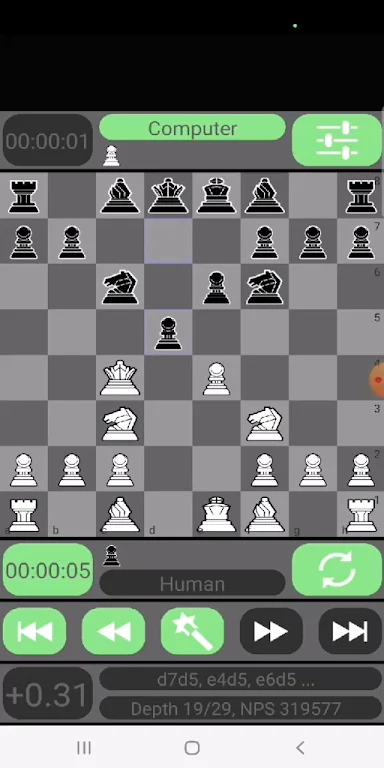
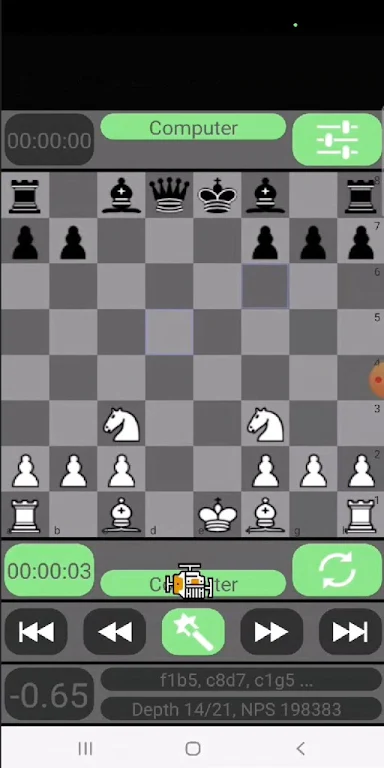
Bagatur Chess Engine arrives as an open-source, self-contained chess program that combines a compact graphical interface with a configurable opponent for practice, study, and casual competition. Bagatur Chess Engine is built to run offline on a single device, offering human-vs-computer play and local two-player (pass-and-play) matches while exposing adjustable detail when you want to analyze the engine’s decision-making. The app is lightweight, straightforward to use, and designed for players who want a reliable sparring partner as well as hobbyists who enjoy inspecting engine behavior.
The interface is bundled with the engine so you can start a game immediately without external setup. Sixteen distinct strength levels let you scale the challenge from beginner-friendly positions to very advanced play, and at stronger settings the program reveals search information to help you study why certain moves are chosen. The engine’s estimated playing strength is around 3000 ELO in some reported tests, producing a distinctive and occasionally surprising style that keeps practice sessions instructive. Gameplay controls include side selection (Human/Computer), board flip, and two input modes: drag-and-drop or square-to-square moves, along with move navigation to step backward and forward through a game for review.
Moves are entered directly on the on-screen board using intuitive controls, and the interface focuses on clarity so you can concentrate on pattern recognition and planning. If you prefer tactile input, drag-and-drop feels natural; if you prefer precision, clicking or tapping squares to move can reduce accidental piece placement. The move navigation keys make it easy to replay entire lines or to jump to critical positions, which is useful when you pause a session to analyze a tactical motif or to study an endgame sequence. Search information becomes visible from level 5 upward, giving you access to nodes, principal variation lines, or evaluation insights depending on the depth selected, which turns casual games into learning opportunities.
The sixteen-level progression is designed to be gradual: early levels simplify tactics and avoid deep calculation so beginners can gain confidence, while mid and high levels increase search depth and tactical awareness to challenge more experienced players. Because strength increments are discrete, you can systematically raise the difficulty as your play improves, using lower levels for pattern training and higher ones for full-game endurance tests. The engine’s tendency toward creative or non-standard moves at some settings encourages players to think independently rather than always relying on memorized lines, which supports long-term improvement.
Bagatur Chess Engine is packaged as an open-source project, so users who want to examine the source code or study the engine’s inner workings can do so. The built-in ability to show search information at deeper settings is particularly valuable for students of the game: you can observe why the engine prefers one candidate over another, follow principal variation lines, and step through alternatives to see where tactics arise. While the GUI is not an engine-exchange platform and does not accept third-party engine imports, the bundled environment offers a fast path from position setup to analysis without additional configuration.
The visual presentation emphasizes readability: a clean board, clearly contrasted pieces, and minimal distraction let you keep focus on calculation and strategic planning. Flip-board support makes it easy for two players sharing a device to swap sides, and the layout keeps controls close to the playing area to speed routine actions like undoing a move or jumping to the start of the game. Because Bagatur Chess Engine runs entirely offline, it’s suitable for use on flights, during commutes, or in low-connectivity situations where internet-dependent services are impractical.
Replay value comes from the combination of sixteen difficulty tiers and the engine’s unpredictable tendencies at certain settings; short training sessions, deep analytical reviews with search display enabled, and evening sparring matches with a friend all remain engaging. The app is accessible to newcomers thanks to its simple controls, and it also provides satisfying depth for experienced players who want a challenging offline opponent that can simulate advanced play without requiring online accounts. Keep in mind the engine is not intended to match the absolute top-tier performance of specialized modern super-engines, and the interface does not serve as an exchange platform for other engines, but within its scope it offers a stable, instructive, and compact chess experience.