
Spotted
Version: 1.3.3
3.00MB
4.4
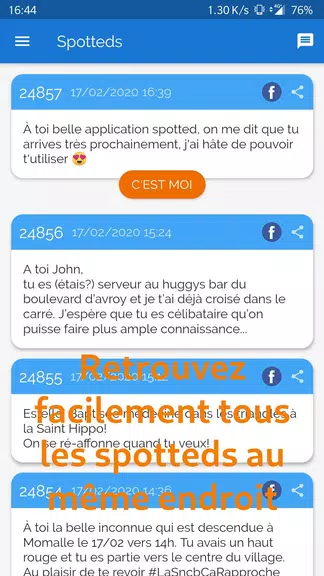

Spotted is an app designed to help you reconnect with people you met briefly by letting you post a short, anonymous description of someone you'd like to find. The idea is simple: write where and when you saw the person, add a concise description that would help recognition, and publish a single public post that other users can check. Spotted places privacy and simplicity first, so identities remain hidden until both parties choose to reveal themselves, and the interface keeps composition, browsing and response options in one central place.
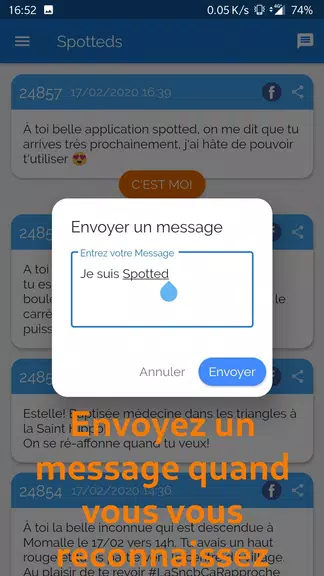
The core interaction model is straightforward and intentionally lightweight. When you create a post you type a short, anonymous description and include contextual details such as approximate time, location, clothing, or other non-sensitive identifiers; nothing in your profile is exposed by default. Other users browse an organized chronological list of posts and scan descriptions to see if any refer to them. If someone recognizes a description and wants to respond, they press the app's confirmation control to initiate an anonymous exchange. That exchange remains masked until both participants explicitly agree to reveal their identities. Controls are minimal: compose, publish, browse, confirm 'It's me' and reply. Notifications alert you to replies and confirmations so you can follow the conversation without having to stay in the app indefinitely.
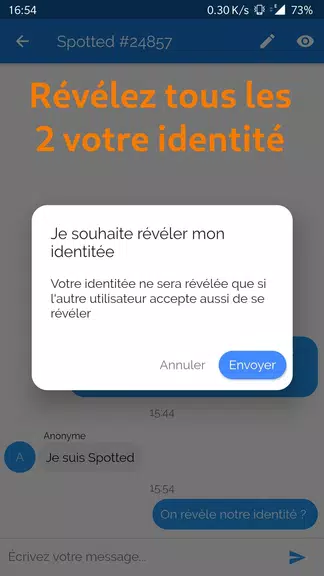
Creating a post takes only a few taps and is optimized for short, readable descriptions rather than long narratives. The compose controls include a character-aware editor that guides you to include useful context without encouraging excessive detail; you can edit or delete your post later and manage visibility settings from a single screen. The messaging interface opens as an anonymous conversation thread when a match confirms the description; messages behave like a private chat where usernames are replaced by neutral placeholders until identity reveal is mutual. The control flow is designed to reduce accidental disclosures and to make it obvious when identities will become visible, so you always know what will happen before you confirm anything.
Spotted emphasizes repeated, small interactions rather than long matchmaking sessions. Progression is experiential: your chance of connecting improves as you refine how you describe meetings, learn best-practice wording, and become familiar with peak posting times for your area. The app keeps a history of your posts and conversations so you can revisit threads, update a description, or republish a revised post if the first attempt didn't yield results. For many users this creates natural replay value—crafting better descriptions, checking the feed regularly, and following up on conversations become an accessible routine rather than a time-consuming process.
The visual design favors clarity and readability with a neutral color palette, clear typography and high-contrast elements to make scanning the centralized list comfortable on both small and large devices. Cards are organized so location and time are visible at a glance, and conversation threads use a simple, linear layout with consistent spacing. Accessibility features include adjustable font sizes, basic screen reader compatibility, and touch-friendly controls for users who prefer larger tap targets. The interface avoids clutter so that composing, browsing and responding feel intuitive whether you are a first-time user or someone who checks the app regularly.
Some functionality is available offline: you can draft new posts without an active connection and the app will upload them when connectivity returns, while recently viewed posts are cached so you can re-check descriptions in low-coverage areas. All identifying information is hidden by default and identity reveal only occurs when both participants explicitly agree, which helps maintain privacy. Spotted also provides in-app options to block or report posts and users, and to remove your own content at any time. These controls are presented transparently so you can manage your presence and data retention preferences from the settings screen.
No system guarantees a match: success depends on whether the person you described uses the app and recognizes your post. Keep descriptions specific enough to be recognizable yet respectful of privacy and safety. Avoid including exact personal contact details in public posts; instead rely on the app's anonymous conversation flow to start a private exchange. If you need to increase visibility, consider reposting with clearer context or adjusting posting times to match when the other person might be active. With modest expectations and careful descriptions, Spotted can serve as a discreet, privacy-focused tool to reconnect with someone you crossed paths with.