Kiolix Pulse - Global Trends
Version: 1.1.1
41.00MB
4.5

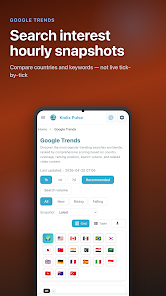
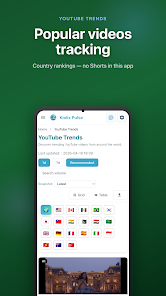
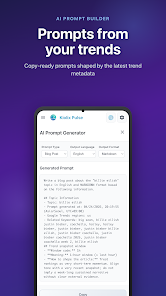
Kiolix Pulse - Global Trends is a compact trend explorer that aggregates rising signals from major online sources into a single, hourly-updated feed, helping marketers, journalists, developers and curious users discover what’s gaining attention worldwide. The app surfaces country-level search snapshots, video popularity cues, community discussion themes and tech headlines, and converts trend metadata into copy-ready prompts for immediate use. Completely free and requiring no sign-up, Kiolix Pulse - Global Trends offers Korean and English interfaces and in-app browsing to make monitoring global shifts quick and convenient on mobile devices.
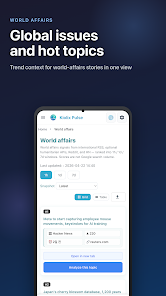
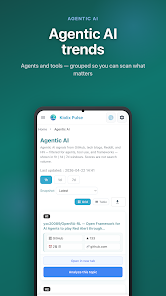
⭐ World affairs and agentic AI topic view: see international issues and AI tooling shifts with contextual summaries.
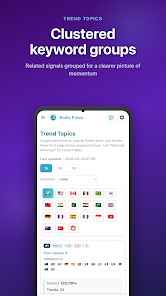
⭐ Hourly country-level search snapshots with rising keywords and clustered related-search maps.
⭐ Country and keyword side-by-side comparisons to spot regional differences and timing.
⭐ Video trend tracking by country and timely popularity signals from major streaming sources.
⭐ Community and tech discussion feeds aggregated from popular forums and developer news hubs.
⭐ AI Prompt Builder creates copy-ready prompts from the latest trend metadata, plus push notifications and deep links for quick access.
✅ Completely free to use with no account required, so you can start exploring trends immediately.
✅ Data refreshed roughly every hour keeps you informed of recent shifts without being overwhelming.
✅ Kiolix Pulse - Global Trends supports Korean and English UIs and surfaces multi-language trend pages based on device settings.
✅ In-app browser and full Android back navigation support make it easy to follow external links and return to your workflow.
✅ Built-in prompt generation helps turn trend insights into usable content ideas or research starting points.
❎ Trend data updates about once an hour, so it may not reflect true real-time spikes.
❎ No account system means limited personalization or saved historical tracking tied to a user profile.
❎ Interface languages are currently limited to Korean and English, which may restrict accessibility for other speakers.