
Farm City:Farming & Building
Version: 2.10.23
36.00MB
4.1

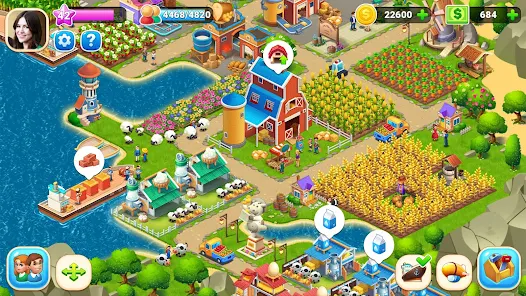

Farm City:Farming & Building invites players to manage a cozy agricultural enterprise while shaping a growing urban center, combining crop and livestock care with factory production and city planning in a calm, easygoing package. The game puts you in the role of a relaxed mayor who plants, harvests and processes produce, looks after animals, builds restaurants and factories, decorates streets and public spaces, and explores quieter challenge areas such as ancient underground zones — all presented in bright 3D cartoon-style visuals with a clear offline play option for flexible, on-the-go enjoyment. Farm City:Farming & Building balances slow-burn progression and creative customization so players can develop a small farm into a thriving mini-metropolis at their own pace.
The core loop mixes farming tasks, production chains and urban development: plant seeds, tend crops, feed animals, and move raw goods through processing buildings to create higher-value items for sale or display. City-building elements let you place factories, restaurants and decorative landmarks to influence income and citizen satisfaction. Time-limited events and rotating market stalls periodically change available resources and goals, while surprise attractions provide short-term rewards that break up routine play without forcing constant attention.
Controls are designed for touch devices with simple taps and drags to plant, collect and place buildings, and clear land. Context-aware menus streamline routine management: tapping a field shows planting and harvesting options, tapping a production building displays current queues and upgrade paths. Resource management emphasizes planning rather than frantic micromanagement, and players can queue tasks or check progress later thanks to the offline mode that continues core processes when the app is not active.
Progression in Farm City:Farming & Building is driven by a combination of crop cycles, building upgrades and unlockable production recipes. Gaining experience and income unlocks new tiers of crops, livestock and factory types. Upgrades shorten processing times, increase yields and open aesthetic options for buildings. Players see steady advancement through a tiered tech tree that rewards investment in both farm efficiency and city amenities, encouraging balanced play between agricultural output and urban attractiveness.
Production emphasizes chaining raw materials into finished goods: farm outputs feed into mills, bakeries or canneries, which then supply restaurants and market stalls. The in-game bank and basic finance mechanics let you invest gold to stabilize long-term growth, and alternating demand from city residents creates natural choices about whether to focus on quick-turn crops or higher-value processed items. This economic layer gives decisions weight without overwhelming casual players.
The art direction favors a warm 3D cartoon aesthetic that keeps the scene readable and cheerful on small screens. Buildings and decorations offer a range of customization options so you can personalize your city’s layout and skyline. Cosmetic choices affect the look of streets, parks and storefronts, while upgrade tiers change building models and animations, providing visible rewards for progression and design experimentation.
Rather than a strict linear campaign, the game uses a flexible level and task structure consisting of daily missions, multi-stage projects and optional challenge zones such as ancient underground areas where mining and crafting opportunities are concentrated. These areas reward exploration with rare resources that are useful for advanced upgrades. Time-limited events create focused objectives that refresh gameplay and introduce short-term mechanics to keep long-term play engaging.
Social interactions are intentionally light: invite friends, visit neighbor towns, trade items and assist others to strengthen community ties without competitive pressure. These features are optional and designed to complement solo play rather than require it. Offline play preserves core progress while you’re away, letting farms continue basic processes and holding queued production so returning players can pick up where they left off without losing momentum.
Menus and prompts are kept concise and readable, with adjustable sound and simple visual cues to help navigation. The control scheme is forgiving for new players and includes tooltips and a gradual tutorial that introduces mechanics over several sessions. Difficulty and pacing are customizable through optional settings, so casual players can emphasize aesthetics and steady growth while more engaged players can optimize production chains and event participation.
Farm City:Farming & Building supports ongoing play through seasonal events, rotating shop inventories, and a variety of production and design goals that encourage revisiting older areas with new strategies. Because the game blends farming routines with city management and occasional exploration, it offers multiple paths to satisfaction whether you prefer methodical planning, creative layout work or collecting rare resources from challenge zones. Regular updates and evolving in-game events keep the experience fresh while preserving a relaxed, approachable pace.