Farm Land
Version: 2.2.11
262.80MB
4.4
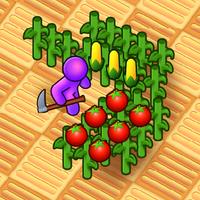
Farm Land is a casual, top-down farming game that puts you in control of a stickman tending a growing plot of land. In Farm Land you plant, water and harvest vegetables across short, focused rounds, trade produce for cash, and unlock new adjacent fields to gradually expand your operation; the description below outlines the core systems and experience so you know what to expect before downloading.
The core loop in Farm Land is straightforward and designed for brief play sessions: choose seeds, plant them in available plots, use a circular action button to tend crops, and harvest when ready. Each round presents a compact map that encourages efficient movement and planning, with limited space requiring you to prioritize which crops to grow. Produce converts into in-game money, which you then reinvest to unlock neighboring plots and access additional crop types. The result is a steady sense of progression without complex micro-management, making it a relaxing option for players who prefer light strategy rather than deep simulation.
Controls are intentionally simple to keep the game approachable. A combination of tap actions and smooth swipe gestures moves your stickman around fields, while a central circular action button handles planting, watering and harvesting. These mechanics work well on phones and tablets and are responsive even during faster-paced rounds. Farm Land also offers basic accessibility choices: the interface uses clear symbols, buttons are sized for touch accuracy, and control sensitivity can be adjusted so players with different dexterity levels can enjoy the game comfortably.
Progression in Farm Land is driven by a cash economy and a segmented level structure made up of rounds. Each round acts like a mini-stage where your choices matter but the time commitment stays short. Earning money from harvests lets you buy access to adjacent plots and gradually stitch together a larger farm. As you open new areas, opportunities for more efficient layouts and higher-value crops appear, creating a natural difficulty curve and a small puzzle element around space management. The pacing rewards steady play: short-term goals keep rounds satisfying, while longer-term expansion gives a clear objective to work toward.
Vegetable crops are the backbone of the game, each with their own growth times and resale values that influence planting decisions. Farm Land also includes basic animal options like cows, sheep and chickens, which add predictable resource streams and a touch more variety to your daily routine. Animals require minimal tending compared to crops but can diversify income and give you different planning considerations. The in-game economy is simple and transparent: sell produce to generate cash, weigh the cost of unlocking new plots against immediate earnings, and build a balanced operation that supports your expansion goals.
The visual presentation favors clarity and minimalism. A top-down view keeps the whole farm visible, and the stickman characters are deliberately simple so the focus remains on layout and decision-making. Farm Land allows you to arrange your fields and pathway placement to suit your workflow, and small cosmetic touches—such as selecting a different outfit color for your stickman and placing decorative items—let you personalize the farm’s appearance without affecting core gameplay. The result is an uncomplicated aesthetic that helps new players understand the game state at a glance.
Although Farm Land is deliberately easy to learn, the game scales challenge through tighter budgets, limited plot space and the need to optimize planting schedules. Later rounds require more careful planning to keep income steady and to unlock the next batch of land. Short-term objectives and the desire to perfect efficient layouts create replay value: you can revisit earlier stages to improve your score or try different crop combinations and animal mixes. The game is designed to reward experimentation rather than punish mistakes, which keeps play sessions stress-free and engaging over multiple sittings.
Farm Land is built for solo, offline play so you can jump in anywhere without needing a constant connection. The interface emphasizes quick feedback—clear icons, satisfying harvest animations and concise progress indicators—so players always understand how close they are to unlocking the next field. Tutorials are woven into early rounds to teach mechanics gradually, and the overall user experience favors accessibility and short, repeatable activities that fit into busy days.