
Whorehouse Manager
Version: 0.1.3
48.00MB
4.3
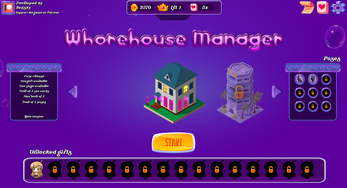

Whorehouse Manager is a management-focused simulation that places you in charge of an adult-themed establishment, asking you to balance finances, reputation, staff welfare, and customer satisfaction. The game frames mature subject matter in a strategic context, focusing on decision-making, resource allocation, and long-term progression rather than explicit content. Players who enjoy slow-burn strategy and simulation titles will find the core loop familiar: recruit and manage staff, upgrade facilities, and respond to dynamic events that influence income and public perception.
The title offers a range of systems common to management sims but tuned to its setting. Staff recruitment and assignment are central: each hire brings different strengths and weaknesses, and careful scheduling and role placement improve overall performance. Facility upgrades unlock new services and operational efficiencies while customization options allow cosmetic changes that signal quality improvements to customers. Decision-driven outcomes matter; choices you make about pricing, marketing, and risk will affect the business ledger and the establishment's reputation over time. Whorehouse Manager emphasizes strategic trade-offs rather than sensationalism, making economic planning and staff management the heart of the experience.
Gameplay unfolds across repeated play sessions in which you plan each day, handle emergent events, and analyze results to inform future choices. Daily operations include setting opening hours, allocating budgets for maintenance and staff training, and responding to incidents that require quick decisions. A risk-reward system means that high-profit choices may carry reputation costs, while conservative strategies yield slower but steadier growth. Randomized scenarios and scripted challenges combine to keep each run varied and to reward adaptive playstyles.
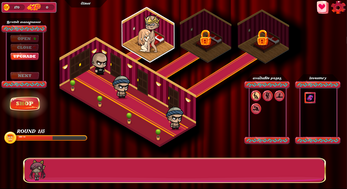
Controls are designed for tap-and-drag input on touchscreen devices, with clear menus for staff lists, upgrade trees, financial reports, and event logs. Tooltips explain complex mechanics and contextual prompts guide new players through initial decisions. The user interface prioritizes readability: charts and simple graphs present income and reputation trends, while straightforward icons indicate staff status and task assignments. Controls are responsive and meant to scale comfortably between phones and tablets.
Progression combines incremental upgrades with scenario-based goals that unlock new content as you expand. An experience-like system rewards long-term planning through unlockable improvements to facilities and managerial abilities, while milestone objectives introduce new mechanics gradually. Whorehouse Manager balances micro-decisions, such as daily staffing, with macro-goals like expanding to additional floors or diversifying services. Persistence between sessions lets you build toward larger ambitions without forcing marathon play.
The visual approach is muted and functional, prioritizing clear icons, readable text, and discrete character silhouettes rather than explicit imagery. Environments are represented with modular rooms that can be upgraded and rearranged; level structure progresses from a modest single-floor operation to multi-room facilities with specialized areas. Visual feedback highlights the effects of upgrades and staffing changes so you can see the consequences of your management choices at a glance.
Customization focuses on operational and cosmetic choices that influence gameplay and presentation. You can prioritize different upgrade paths to create distinct operational styles: efficiency-oriented layouts that minimize costs, or higher-end configurations that aim for premium customers and better reputation. Procedural event mixing and multiple viable strategies produce replay value; experimenting with staff mixes, pricing schemes, and risk profiles creates diverse outcomes over repeated playthroughs, encouraging new approaches and strategic experimentation.
The game aims to be approachable with gentle difficulty scaling and a tutorial that introduces mechanics step by step. Accessibility options include adjustable text size and simplified display modes for users who prefer reduced visual clutter. Whorehouse Manager supports offline play so you can progress without a constant network connection; all core systems function locally and saved progress syncs to the device. Performance targets are modest to ensure smooth play on a wide range of Android devices.
Challenge comes from balancing competing priorities: payroll versus investment, growth versus reputation, and short-term income versus long-term stability. Event difficulty scales with the size of your operation, and optional scenarios provide higher-stakes tests for players seeking a tougher experience. Pacing is deliberately measured, favoring thoughtful strategy and planning; however, players can tailor the tempo by choosing aggressive expansion or conservative steady growth paths. The result is a management simulation that rewards planning, adaptation, and attention to detail while treating mature themes in a restrained, non-explicit manner.