
Holy Shaft
Version: 1.0
158.64MB
4.4



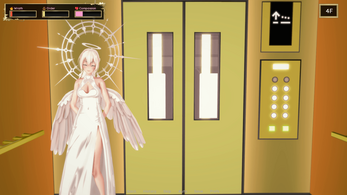

Holy Shaft is an elevator-themed isekai mini-game that drops players into a rapid succession of choice-driven encounters across ten distinct floors; this compact title is designed for short, repeatable runs that typically last between five and fifteen minutes. Holy Shaft places emphasis on situational storytelling and branching outcomes rather than long-form narrative campaigns, so each playthrough feels focused and self-contained while still offering room for discovery on repeat plays. The interface is intentionally minimal and direct, letting the decision points and consequences remain at the center of the experience.
The core gameplay in Holy Shaft is straightforward: you travel floor to floor, encountering short scenes that present a handful of clear options. Controls are simple and optimized for touchscreens—tap to select choices, and the UI highlights available actions and results so new players can jump in without a steep learning curve. There are no complex menus or inventory systems to manage; instead the game emphasizes rapid decision-making and immediate feedback. On-screen prompts and brief descriptions guide you through each encounter, with consistent pacing that supports the game's 5–15 minute session length.
Progression in Holy Shaft is driven by branching choices rather than traditional leveling or resource systems. Decisions on earlier floors can open or close branches on later floors during the same run, creating emergent narrative arcs and multiple possible endings. Because each run is brief and self-contained, the game encourages repeated play to explore alternate outcomes, test different strategies, and uncover less common scenarios. The ten-floor structure gives a clear sense of scope while leaving room for optional variations that appear only under certain choices, which contributes to high replay value without requiring a large time investment.
Each of the ten floors in Holy Shaft hosts a distinct situational encounter that reacts to your inputs, so the challenge comes from weighing trade-offs and anticipating how choices will ripple through the remainder of a run. Floors vary in tone and stakes to keep the experience fresh, and the design favors clarity over ambiguity—responses to your decisions are immediate and understandable, which helps players learn from each run. The game does not rely on reflex-based mechanics; instead it tests reasoning, curiosity, and willingness to experiment.
The visual presentation is deliberately restrained to support fast play and readability. Holy Shaft focuses on clean layouts, legible typography, and clear visual cues for available choices; this keeps attention on the narrative beats rather than flashy graphics. The simple aesthetic also helps the game perform well on a wide range of Android devices and keeps file size modest. Menus and dialog are organized to provide quick access to play again or review outcomes, streamlining short sessions and making the app well suited to play-on-the-go.
Accessibility is considered through readable text sizes and straightforward interaction patterns that require only basic touch input. The game's pacing and short sessions make it suitable for players who prefer concise gameplay bursts, and its minimal reliance on online services means Holy Shaft runs fully offline once installed. This makes it easy to play without a persistent connection and reduces interruptions from background network activity.
Holy Shaft does not attempt to be a deep simulation or an RPG with complex customization; instead it offers a focused, experimental slice of a larger creative idea. Players should expect a self-contained experience with limited mechanical customization—there are no equipment trees or skill points—but the variety comes from narrative branching and the interplay between floors. The title functions as a compact, replayable narrative experiment rather than a sprawling, highly customizable game.
Players who enjoy inventive indie concepts and short, decision-centric gameplay will likely appreciate Holy Shaft. The game is ideal for playing during short breaks, commutes, or when you want a quick interactive story that rewards curiosity and multiple attempts. Those seeking long-form epic narratives or deep progression systems may find the content concise by design, but the branching outcomes and distinct floor encounters offer a lot of variety within a small package.
Holy Shaft is a standalone release from an independent developer who decided to offer this segment of a larger, shelved project as a compact experience. The release is presented as-is to preserve the experimental feel of the original concept, and the developer has a history of small, focused projects in the same spirit. This build aims to deliver a polished, bite-sized game that runs offline and keeps mechanics intentionally simple to highlight the narrative experiments embedded in each floor.